2026-06-25
Aircraft Technical Log vs Journey Log: What’s the Difference?
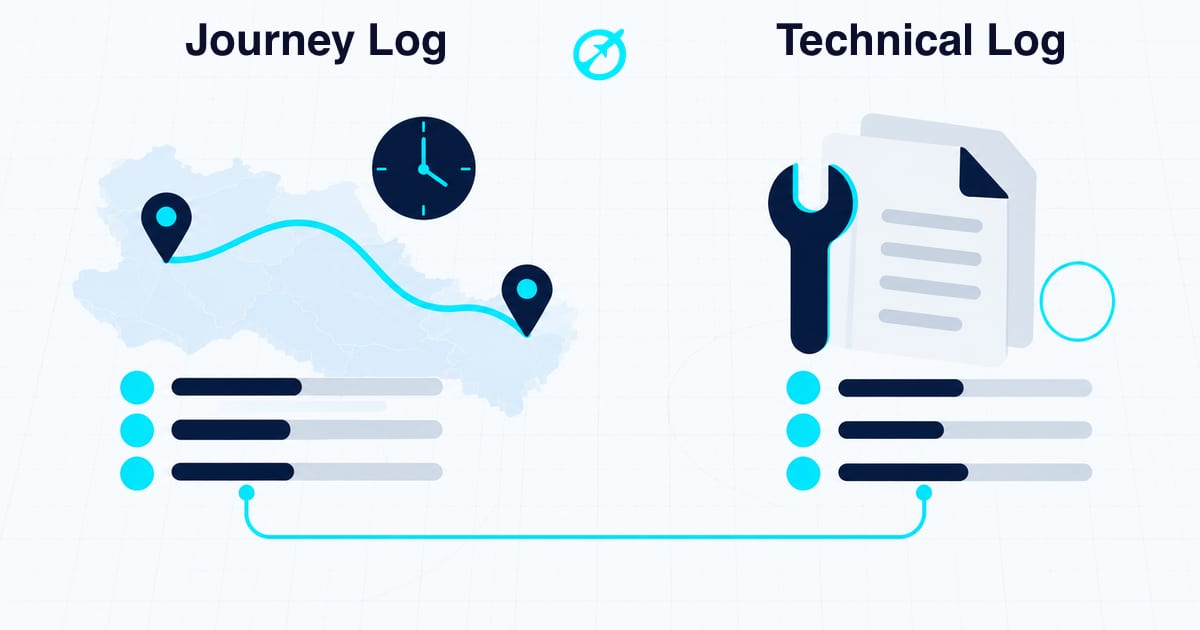
An aircraft technical log and a Journey Log can both carry information about a flight, aircraft use and defects, but the names are not universally interchangeable. In EASA rules, the record you need depends on the operation, the applicable regulatory framework and the record system established for that aircraft.
For a pilot-owner under Part-NCO, ask which aircraft-centred record must preserve the information. A Journey Log may provide flight-by-flight continuity. A formal technical log system belongs to a more specific setting. Part-ML continuing-airworthiness records have a related but different purpose.
What does “Journey Log” mean?
A Journey Log follows the aircraft rather than the individual pilot. It preserves the sequence of flights or series of flights and the operational facts needed to understand the aircraft’s use.
For operations within Part-NCO, NCO.GEN.150 and its acceptable means of compliance are the main starting point. The rule requires specified information about the aircraft, crew and each journey to be retained for each flight or series of flights in a Journey Log or equivalent. The associated AMC describes particulars such as registration, date, crew names and duties, departure and arrival details, flight time, nature of flight, incidents and observations, and the Pilot in Command’s signature, where applicable.
National requirements, the kind of operation and the aircraft’s established process may add context. The core job remains recording what the aircraft did on a particular journey.
If you need the wider owner routine—review before flight, record after flight and preserve open context—see the aircraft Journey Log guide. A separate worked Journey Log entry explains one illustrative flight without turning its fields into a universal form.
What does “aircraft technical log” mean?
“Technical log” is used in two ways. In ordinary aviation conversation, people may use it broadly for a record containing aircraft utilisation, technical observations, defects and maintenance actions. In regulation, however, an aircraft technical log system can be a defined system with a defined scope.
M.A.306 in Regulation (EU) No 1321/2014 requires a technical log system for commercial air transport, commercial specialised operations, and commercial approved or declared training organisation operations within its Part-M setting. It is not a universal Part-ML requirement for every privately operated light aircraft.
Calling a private-aircraft record a “tech log” does not make M.A.306 applicable; calling it a “Journey Log” does not remove an applicable requirement.
Are a technical log and a Journey Log the same record?
Not necessarily. They can overlap in the information they carry, and some rules expressly recognise that the same information may be recorded in either record. But overlap does not make the terms legally identical in every context.
| Record term | Main practical purpose | Regulatory lead | Typical relationship | Applicability question |
|---|---|---|---|---|
| Journey Log or equivalent | Preserve aircraft, crew and journey particulars for each flight or series of flights | Part-NCO, including NCO.GEN.150 where applicable | Aircraft-centred operational sequence | Which operating rules and national requirements apply? |
| Aircraft technical log | Make flight-safety, utilisation, defect and maintenance information available within a defined technical-log system | M.A.306 for its specified Part-M setting | May combine operational entries with current technical status and maintenance release information | Is this aircraft and operation within that formal scope? |
| Part-ML continuing-airworthiness records | Establish current status and preserve evidence about the aircraft’s continuing airworthiness | ML.A.305 | A linked record system, not necessarily one flight-by-flight form | Which Part-ML records must be current and retained? |
| Personal pilot logbook | Record an individual’s flying experience and activity | Flight-crew rules, not the aircraft Journey Log rules | Person-centred; may refer to the same flight | What must this pilot record for licensing purposes? |
This is a terminology map, not a fields checklist. One controlled system may satisfy more than one purpose if the applicable requirements are met. Several linked records may also be appropriate: a Journey Log, current-status records, maintenance evidence and a current view of deferred defects.
Why do the Air Operations rules mention both terms?
For applicable Part-NCO operations, NCO.GEN.105(a)(8) places responsibility on the PIC to record utilisation data and all known or suspected defects after the flight or series of flights “in the aircraft technical log or Journey Log”. The wording recognises that different aircraft and operational settings may use different established record systems.
It does not say that a defect becomes assessed merely because it has been entered. The initial entry establishes what was known or suspected. Under Part-ML, the later decision, any conditions attached to an unrectified item and the evidence of rectification have their own roles. The aircraft defects under Part-ML guide follows that report-to-rectification sequence.
Use the established aircraft record, make the entry promptly and do not hide an open issue where the next PIC cannot find it. That next PIC may be you several weeks later.
Where do Part-ML records fit?
Part-ML addresses continuing airworthiness and maintenance for aircraft within its scope. ML.A.305 requires a system of continuing-airworthiness records containing specified current-status information and supporting records.
They answer questions that a flight row alone cannot settle:
- What is the current status of required maintenance under the Aircraft Maintenance Programme (AMP)?
- What is the current status of applicable Airworthiness Directives (ADs)?
- Which modifications and repairs define the aircraft’s configuration?
- What is the status of life-limited components?
- Which defects remain unrectified and on what recorded basis?
- What maintenance and release evidence supports completed work?
A Journey Log can originate or reference utilisation data or a defect observation, but it does not replace the continuing-airworthiness record system. Connect the flight, report, qualified decision and maintenance evidence without flattening them into one note.
Is the aircraft Journey Log the pilot’s logbook?
No. The aircraft Journey Log follows the aircraft; a pilot logbook follows the person. The same flight may appear in both, but for different reasons.
The aircraft record identifies use and operational history. The personal logbook records the pilot’s experience and duties. A PIC signature is not a Certificate of Release to Service (CRS), which is maintenance release evidence within the applicable context.
One person may be both owner and regular PIC, but ownership responsibility, PIC responsibility and certifying privileges do not merge.
Can the records be electronic?
The Part-NCO AMC for NCO.GEN.150 recognises that Journey information may be recorded in a form other than printed paper when accessibility, usability and reliability can be assured. The medium is only part of the control problem.
For an electronic or mixed record, check that:
- users can retrieve it when needed;
- aircraft, flight and author identity are clear;
- corrections remain intelligible;
- current and superseded information are distinguishable; and
- backup and recovery do not depend on one device.
These controls do not mean every app, signature method or file format is accepted in every EASA state. Check the competent authority’s requirements and the aircraft’s arrangements.
Which name should a pilot-owner use?
Use the name that matches the applicable rule and controlled record system. If a local “Aircraft Technical Log” serves as the Journey Log or equivalent, document that relationship instead of assuming the title resolves every requirement.
Before the next flight, you should be able to answer four questions:
- Where is the authoritative flight-by-flight aircraft record?
- Where are known or suspected defects reported?
- Where is the current status of any unrectified item available to the PIC?
- Where is the supporting maintenance and release evidence retained?
If the answers point to different records, make the cross-references explicit. If they point to one system, make sure the system genuinely preserves each distinct purpose.
The difference between an aircraft technical log and a Journey Log is therefore not simply paper versus digital or a European versus an informal name. It is a question of regulatory context, operational purpose and how the aircraft’s records work together.
Contact Logga about setting up the current Journey Log and controlled document history for your aircraft.
Get insights like this in your inbox
Product updates and practical guides for aircraft owners — no spam, unsubscribe any time.
This content is informational. It is not legal advice. The owner remains responsible under Part-ML. Articles on this blog are created with the assistance of AI and are reviewed for accuracy; we recommend verifying regulatory details with official sources.