2026-03-03
AD vs SB – What Every Aircraft Owner Must Understand
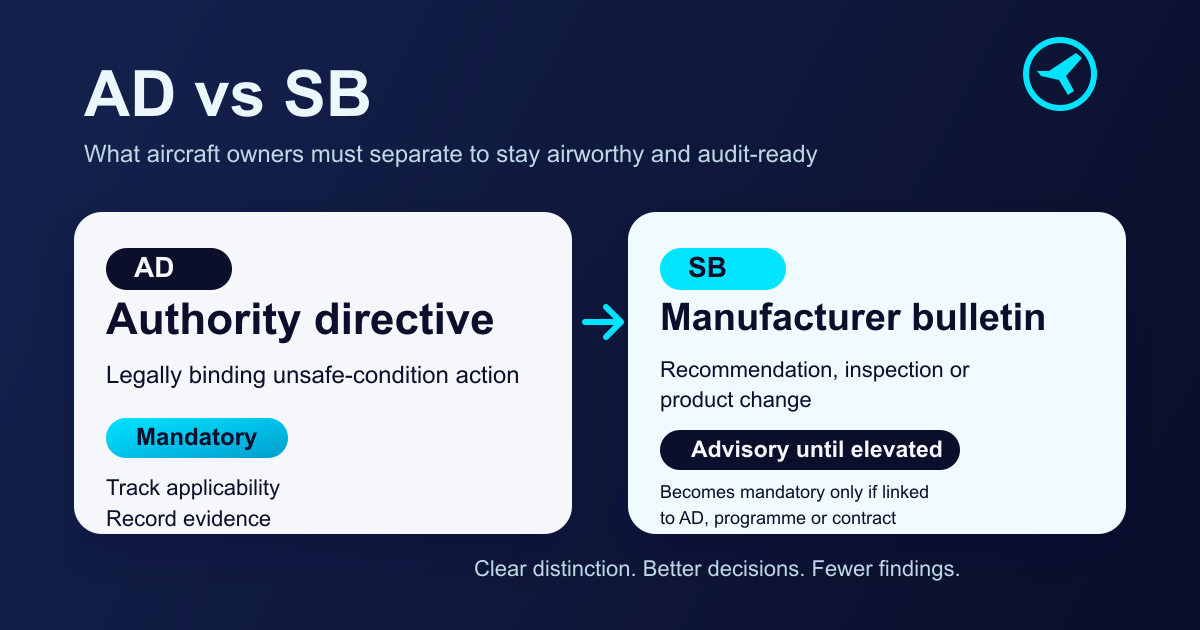
As the owner — and often the pilot — you are legally responsible for airworthiness. A common confusion is mixing Airworthiness Directives (AD) with Service Bulletins (SB): some owners treat every document as mandatory and over-maintain; others overlook manufacturer recommendations until the authority or an audit raises a finding. This article sets out the distinction and what it means for compliance and daily operations.
1. Regulatory Context – What AD and SB Actually Are
What is an Airworthiness Directive (AD)?
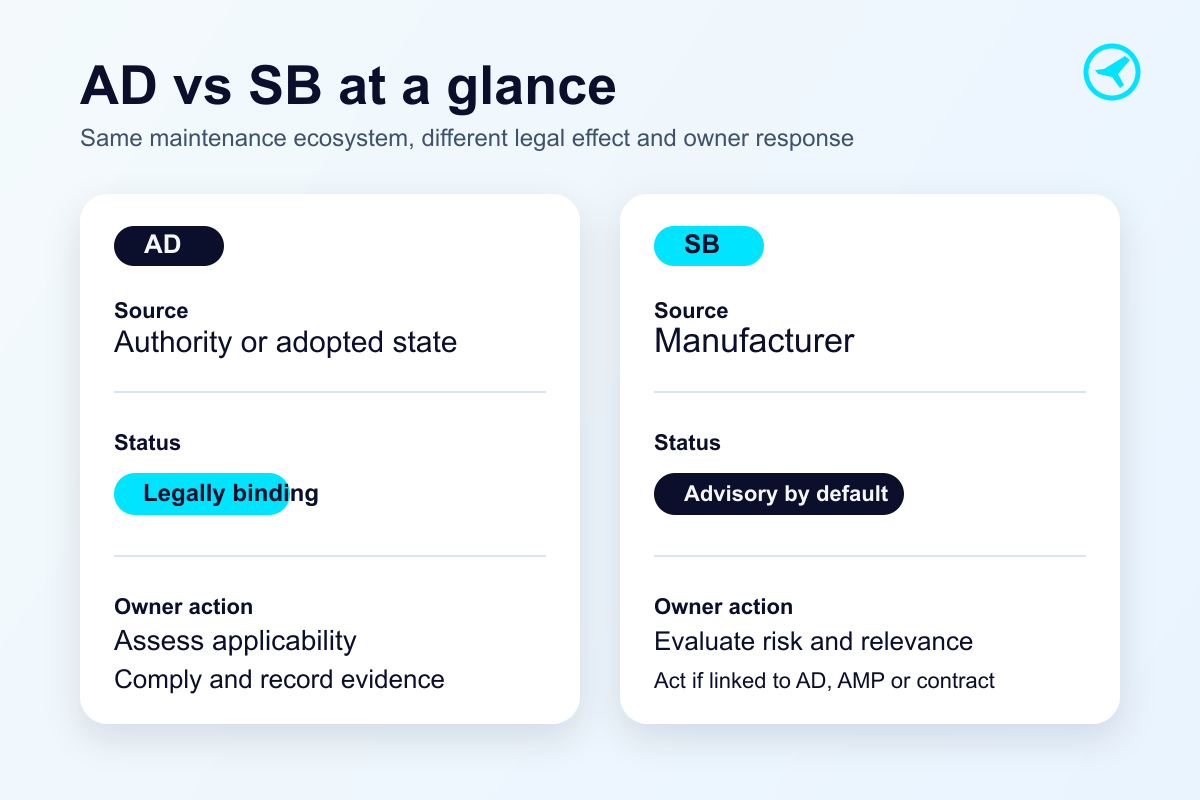
An Airworthiness Directive (AD) is continuing airworthiness information issued by the aviation authority, and it is legally binding. It states what you must do to correct an unsafe condition. If an AD applies to your aircraft, engine, propeller, or an appliance you operate, you must comply — there is no discretion. EASA publishes ADs on its Airworthiness Directives page, which also links to the Safety Publications Tool so you can search and subscribe to what applies to your type.
In practice, ADs are enforceable on a per-aircraft or per-component basis; they can be one-time or recurring, and they often specify a “terminating action” (a fix that closes the requirement) or refer to a Service Bulletin as the acceptable method of compliance. If you do not comply with an AD that applies to you, the aircraft is not airworthy.
What is a Service Bulletin (SB)?
A Service Bulletin (SB) comes from the Design Approval Holder—the manufacturer. It can cover safety recommendations, product improvements, inspection procedures, or optional modifications. The crucial point: an SB is not mandatory by default. It only becomes something you must do if (1) it’s referenced in an AD, (2) you’ve included it in your maintenance programme, or (3) a contract says so—for example a lease, a CAMO agreement, or insurance. Getting that distinction right is the basis for everything that follows.
2. Owner Responsibility – Where Accountability Actually Sits
Under European continuing airworthiness rules (e.g. ML.A.201), you as the owner are responsible for making sure the aircraft is airworthy before flight. That means all applicable ADs are complied with, no required maintenance is overdue, the aircraft matches its approved configuration, and the paperwork is in order.
An important point: a Certificate of Release to Service (CRS) does not transfer that responsibility to the engineer. The CRS certifies only that the specific work on the form was done correctly. It does not say that every AD is complied with, that the aircraft is airworthy overall, or that no life or overhaul limit has been exceeded. For more on what a CRS does and doesn’t certify, see What Does a CRS Really Mean?. Airworthiness is the state of the aircraft; maintenance is what we do to keep it there. They’re related, but they’re not the same thing.
3. When Does a Service Bulletin Become Mandatory?
| Situation | Is SB Mandatory? | Why |
|---|---|---|
| SB referenced by an AD | Yes | AD is legally binding |
| SB included in declared maintenance programme | Yes | You committed to it |
| SB required by leasing/CAMO contract | Operationally yes | Contractual obligation |
| SB issued as manufacturer recommendation only | No | Advisory unless elevated |
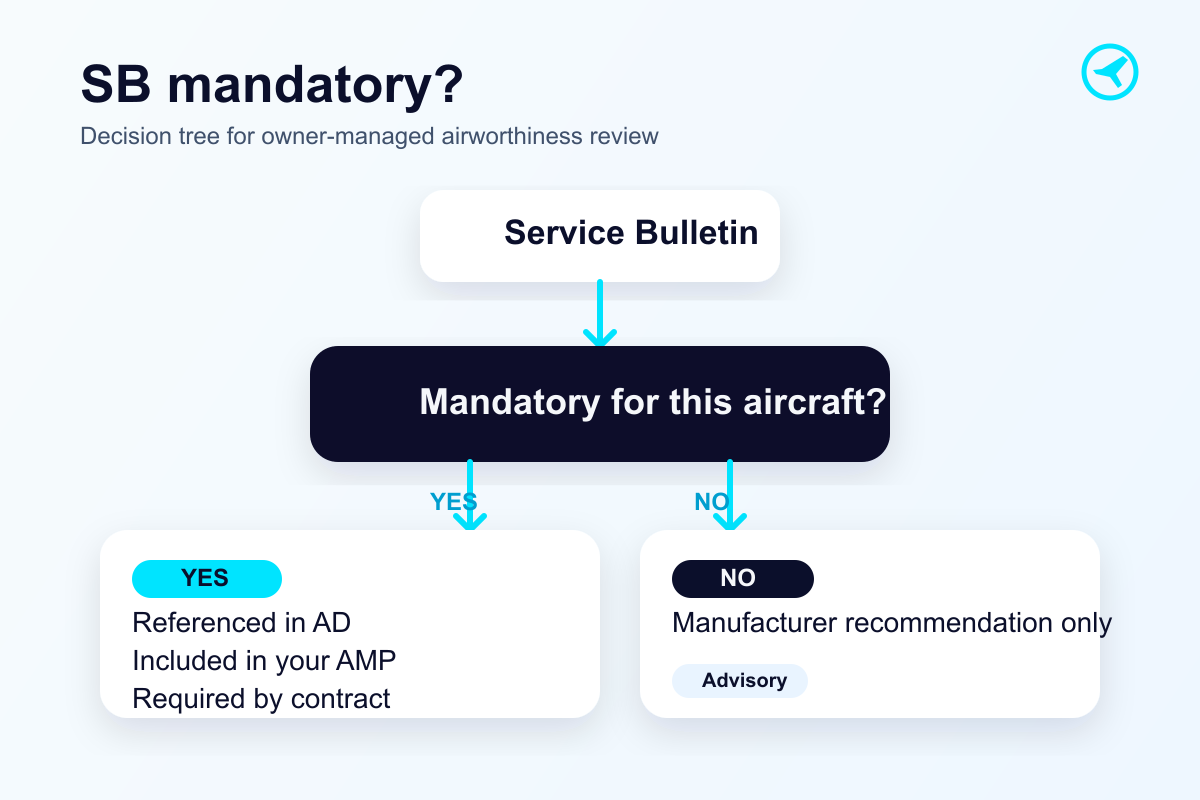
A lot of owners trip over the words “Mandatory SB” in manufacturer docs. The manufacturer can call an SB “mandatory” all they like—that doesn’t make it legally mandatory for you. It only becomes something you must do when the regulator turns it into an AD or when you’ve included it in your own maintenance programme.
4. The Most Common Owner Mistakes
1. Checking Only Aircraft ADs
It’s easy to run through ADs for the airframe and stop there. Don’t. You also need to cover engine, propeller, appliances, and ETSO equipment. Auditors routinely find an incomplete AD review scope when owners only look at the type certificate.
2. No Documented AD Status List
Saying “we’re compliant” isn’t enough. You need something you can show: AD number, applicability assessment, how you complied, revision, date of compliance, and for recurring ADs the interval and next due. Without that, you can’t demonstrate traceability, and that’s a classic audit finding. See 12 Most Common Part-ML Audit Findings for more on what auditors look for and how to prepare.
3. Ignoring Recurring ADs
Recurring ADs are the ones that bite people. You do the first compliance and then forget to put the next due in the diary—or you change an engine, propeller, or other component and don’t re-check whether a recurring AD still applies or has reset. Overdue recurring AD is one of the most common findings.
4. Confusing CRS with AD Compliance
The CRS only confirms that the maintenance on the form was done. It doesn’t confirm that your AD review is complete or that the aircraft is airworthy overall. That responsibility stays with you.
5. Treating All SBs as Mandatory
If you treat every SB as mandatory, you’ll spend more than you need to, skew your maintenance planning, and create downtime that the regulation doesn’t actually require. The risk is over-maintenance without any real risk-based prioritization.
6. Ignoring SB Until It Becomes an AD
Some SBs are early warning. If a safety-related SB later becomes an AD and you’ve ignored it, you can end up grounded with a short compliance window and higher cost. Keeping an eye on relevant SBs and deciding deliberately what to incorporate reduces that surprise.
5. Risk Scenarios Every Owner Should Consider
Scenario 1 – Overdue AD Found Before Airworthiness Review
Someone spots an overdue AD before your next Airworthiness Review Certificate. The aircraft is grounded, the ARC is delayed, and you’re left dealing with the cost and operational mess. It’s avoidable if you keep AD status under control.
Scenario 2 – Component Replacement Without AD Cross-Check
You fit a new engine, propeller, or other component. The installer may assume everything is compliant, but nobody has re-checked AD applicability for that part. You can end up with hidden non-compliance that only shows up at audit or ramp check.
Scenario 3 – Incident with Uncomplied AD
If something goes wrong and there was an applicable AD that wasn’t complied with, the authority will want to know: was the AD applicable, when did you last review it, and where is the evidence of compliance? Weak documentation pushes liability straight back at you.
Scenario 4 – SB Ignored, Later Elevated to AD
An SB you didn’t act on gets adopted into an AD. Overnight, compliance becomes urgent, lead times bite, and the aircraft can be grounded until the work is done. Proactively evaluating which SBs matter for your operation reduces that risk.
6. A Practical Owner Workflow
A simple system keeps surprises to a minimum.
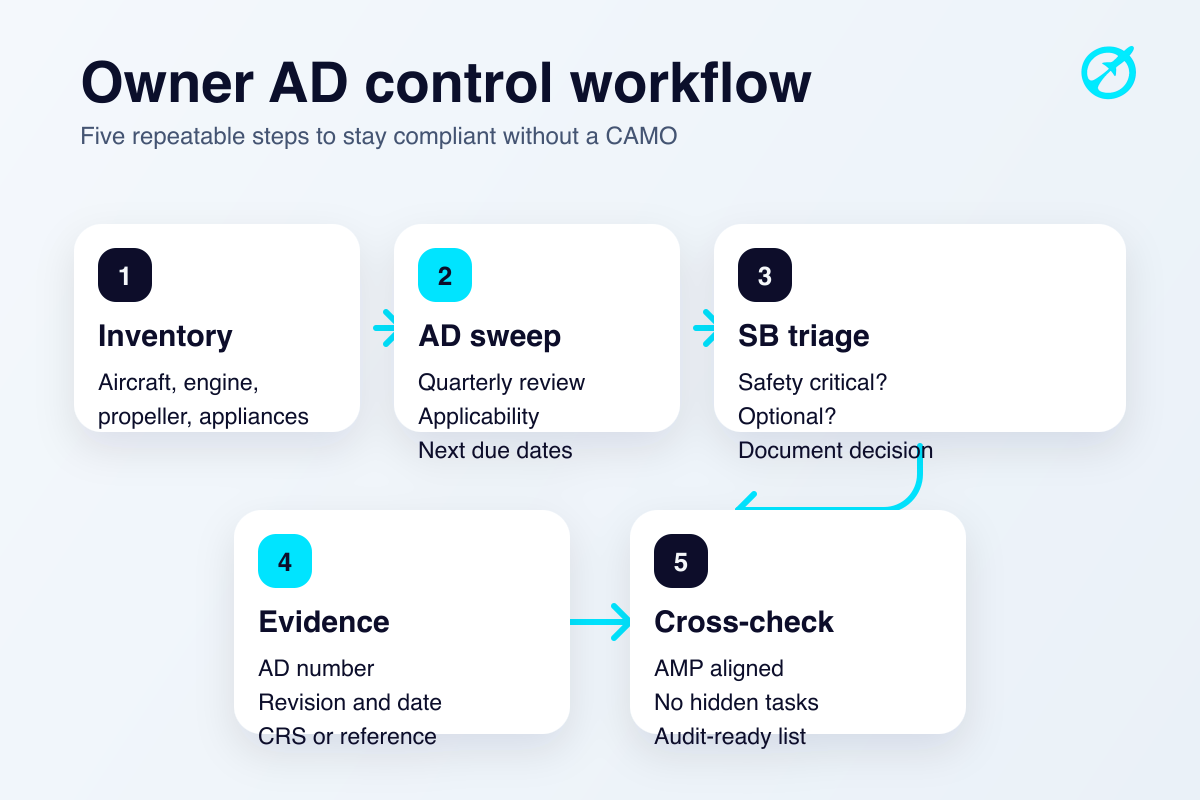
Step 1 – Maintain a Master Component Inventory
Keep a clear list of what’s on the aircraft: type and model of airframe, engine, propeller, major appliances, and any STCs or modifications. That’s your scope for AD and SB review.
Step 2 – Quarterly AD Sweep
Go through the AD databases that apply: aircraft, engine, propeller, appliances. For each relevant AD, document whether it’s applicable or not, whether you’ve complied (one-time or recurring), and the next due date. Do it at least quarterly, and again after any major component change.
Step 3 – SB Triage
For SBs that might affect you, decide how to treat them: safety-critical, efficiency improvement, or optional. Write down your decision so you’re not guessing later why you did or didn’t incorporate something.
Step 4 – Evidence Logging
For every AD compliance, keep a proper record: AD number, revision, how you complied, reference document, date, and signature or CRS reference. If you can’t show it, you can’t prove compliance.
Step 5 – Cross-Check With Maintenance Programme
Make sure your AD list and your declared maintenance programme line up: no task in the programme that contradicts what you’ve committed to, no SB you’ve effectively signed up to without realising, and your AD status list consistent with the tasks in the programme.
7. AD Compliance Checklist
Before you consider yourself on top of ADs: latest AD review date written down, full component scope (aircraft, engine, propeller, appliances) reviewed, recurring ADs tracked with next due dates, terminating actions verified where they exist, evidence for each compliance traceable, and the next review already in the diary.
8. SB Evaluation Checklist
When you look at an SB: safety impact assessed, cross-check with ADs (is it already mandated?), programme inclusion checked (did you commit to it?), rough financial impact considered, and your decision (incorporate or not, and why) documented.
9. Frequently Asked Questions
Can I fly with an overdue AD?
No. If an AD applies and it’s overdue, the aircraft isn’t airworthy. Don’t go. For the full picture on mandatory vs recommended ADs, deferrals, and ferry flights, see Can You Legally Fly with an Overdue AD Under Part-ML?.
Is every Service Bulletin mandatory?
No. Only when the regulator turns it into an AD or you’ve put it in your maintenance programme (or a contract requires it).
Does CRS mean all ADs are complied with?
No. The CRS only covers the specific maintenance on that form. AD status is your job to track.
Who determines AD applicability?
You do. The owner is responsible for making sure applicability is properly assessed and recorded.
What if EASA and FAA AD differ?
What you have to do depends on where the aircraft is registered and what the State of Registry requires. For EASA-registered aircraft, EASA ADs (and adopted foreign ADs) apply.
Can a pilot-owner sign AD compliance?
Only when it’s within the scope of pilot-owner maintenance in your AMP and you document it properly. Many ADs require a CRS from certifying staff—check the AD and your programme.
How often should I review AD databases?
At least quarterly, and every time you change a major component (engine, propeller, etc.).
Can an AD be deferred?
Only if the AD itself allows a deferral or there’s an approved alternative means of compliance. You can’t invent one.
Final Perspective
Airworthiness isn’t maintained by assumption - it’s maintained by documented, traceable, repeatable control. Getting the difference between AD and SB right isn’t academic. It’s what keeps your legal exposure, audit readiness, and day-to-day safety on solid ground.
Get insights like this in your inbox
Product updates and practical guides for aircraft owners — no spam, unsubscribe any time.
This content is informational. It is not legal advice. The owner remains responsible under Part-ML. Articles on this blog are created with the assistance of AI and are reviewed for accuracy; we recommend verifying regulatory details with official sources.