2025-04-30
MIP vs ICA Under Part-ML – When Are You Doing Too Little?
Your Aircraft Maintenance Programme (AMP) under Part-ML must be based on the Minimum Inspection Programme (MIP) and, where applicable, on the Instructions for Continuing Airworthiness (ICA) from the Design Approval Holder. The AMP cannot be less restrictive than the MIP; for many types it should also incorporate or be not less restrictive than the ICA. This article explains the difference between MIP and ICA, the risk of doing too little, and how to interpret the requirements so your declared or approved AMP is compliant and defensible at audit.
1. Regulatory Context
Under ML.A.302, the Aircraft Maintenance Programme (AMP) must be based on the Minimum Inspection Programme (MIP) and, where applicable, on the Instructions for Continuing Airworthiness (ICA) from the Design Approval Holder (DAH). AMC1 ML.A.302(d) addresses the use of the MIP. The AMP cannot be less restrictive than the MIP; for many types it should also incorporate or be not less restrictive than the ICA.
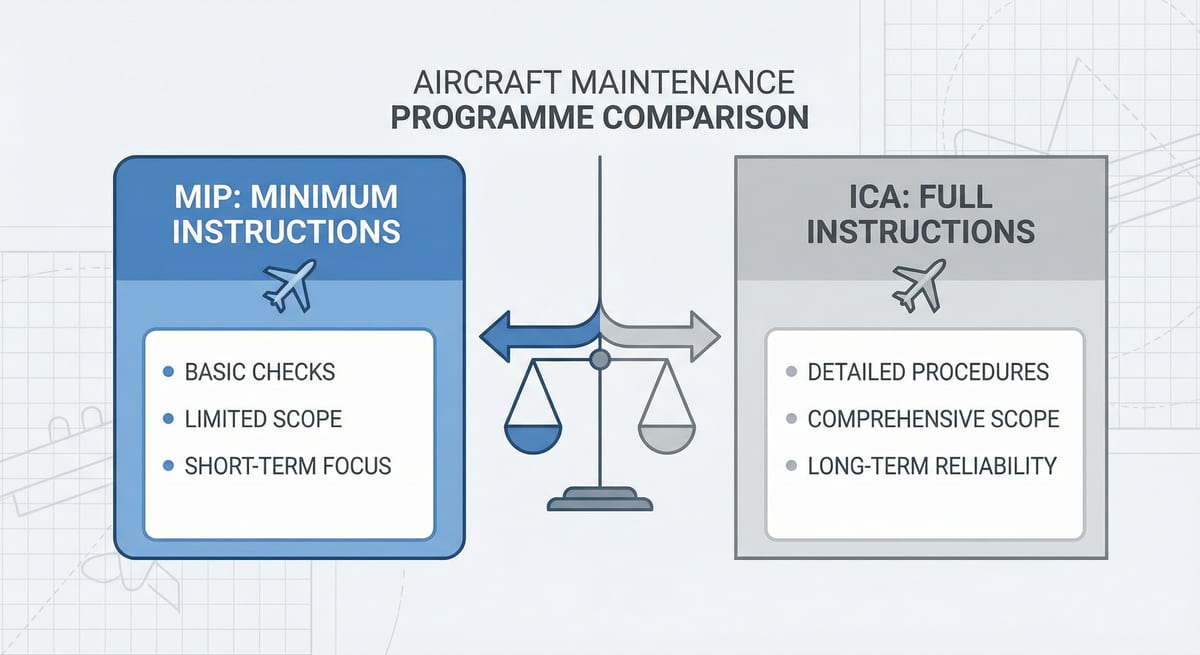
- MIP: The minimum set of inspections and tasks defined for the aircraft type (e.g. in Acceptable Means of Compliance or type certificate data). It is the floor — doing less is not permitted.
- ICA: The DAH’s instructions for continuing airworthiness (inspections, life limits, SBs, etc.). The AMP should incorporate or be not less restrictive than the ICA where it exists and applies.
The legal basis is Commission Implementing Regulation (EU) No 1321/2014 (Part-ML). EASA Part-ML and continuing airworthiness provide the framework. See How to Properly Declare an AMP (ML.A.302).
2. Practical Interpretation
Minimum Inspection Programme (MIP): The MIP defines the minimum tasks and intervals that the AMP must include. If your AMP omits a MIP task or uses a longer interval than the MIP, the AMP is not compliant. Auditors will compare your AMP to the MIP for the type.
Design Approval Holder ICA: The ICA contains the manufacturer’s or type certificate holder’s full continuing airworthiness instructions. For many types, the AMP is expected to incorporate the ICA or to be not less restrictive. Using only the bare MIP when a comprehensive ICA exists may be insufficient — you may miss inspections, life limits, or SB incorporation that the type design assumes. Doing “too little” in that sense creates both compliance and safety risk.
Practical AMP interpretation: Your declared or approved AMP should explicitly reference the MIP (and show that all MIP tasks are included) and, where the type has an ICA, either incorporate the ICA or demonstrate that the AMP is not less restrictive. If in doubt, the safer and more defensible approach is to align the AMP with the ICA for your type.
3. Comparison Table
| Aspect | MIP | ICA |
|---|---|---|
| Source | Defined for the type (authority/AMC/type data) | Issued by Design Approval Holder (manufacturer/TC holder) |
| Legal role | Minimum — AMP cannot do less | AMP should incorporate or be not less restrictive (where applicable) |
| Content | Minimum inspections and tasks for the type | Full DAH instructions (inspections, life limits, SBs, zones, etc.) |
| Owner risk if ignored | AMP below MIP = non-compliant, finding | AMP below ICA = may be insufficient for type, finding or safety risk |
| Typical use in AMP | AMP must include all MIP tasks/intervals | AMP incorporates ICA or is demonstrably not less restrictive |
4. Owner Risk Analysis
Doing too little:
- Below MIP: Any AMP that omits MIP tasks or extends intervals beyond the MIP is non-compliant. This is a direct audit finding and can lead to the aircraft being considered not maintained in accordance with Part-ML.
- Below ICA (when ICA applies): An AMP that does not incorporate the ICA or is more restrictive than the ICA may miss required inspections, life limits, or SB incorporation. That can result in findings and, in the worst case, in latent defects or accidents. The owner is responsible for ensuring the AMP is adequate (ML.A.201).
Who is liable? The owner (ML.A.201). The owner declares or approves the AMP and must ensure it meets MIP and, where applicable, ICA. Contracting a CAMO does not transfer that responsibility.
How do findings occur? Auditors compare the AMP to the MIP (and, where relevant, to the ICA) for the aircraft type. Gaps (missing tasks, longer intervals, or missing ICA content) are raised as findings. See 12 Most Common Part-ML Audit Findings.
5. FAQ
Is MIP enough for my aircraft?
MIP is the minimum — your AMP must at least meet the MIP. For many types, the ICA exists and the AMP is expected to incorporate it or be not less restrictive. So: MIP alone is only “enough” if the applicable regulations and the type do not require more (e.g. ICA). In practice, for most types with published ICA, the AMP should be based on both MIP and ICA. See Declared AMP.
When must I include ICA?
When the aircraft type has Instructions for Continuing Airworthiness from the Design Approval Holder and the applicable regulations or type certification basis expect the AMP to incorporate them or be not less restrictive. If ICA exists for your type, your AMP should include or reference it and show that nothing less restrictive is done. Omitting ICA when it is the standard for the type is a common audit finding and an operational risk.
Summary: MIP is the minimum — your AMP must include all MIP tasks and intervals. Where ICA exists for the type, the AMP should incorporate it or be not less restrictive. Doing less than MIP is non-compliant; doing less than ICA when it applies can lead to findings and safety risk. Align your AMP with both for a defensible programme.
Get insights like this in your inbox
Product updates and practical guides for aircraft owners — no spam, unsubscribe any time.
This content is informational. It is not legal advice. The owner remains responsible under Part-ML. Articles on this blog are created with the assistance of AI and are reviewed for accuracy; we recommend verifying regulatory details with official sources.